
Vermiculite Insulation in Colorado: What It Is, Why It’s Everywhere, and What You Actually Need to Know
It's been a while since we've posted! Let's open a can of worms shall we?
Picture this: you’re poking around your attic (as one does), moving aside some dusty insulation, and suddenly you see what looks like… metallic popcorn? Maybe fish food flakes? Tiny accordion-shaped pebbles?
Congrats!!! You’ve likely met vermiculite insulation.

Before your brain jumps straight to worst-case scenarios, let’s walk through what this material actually is, why it shows up in so many Colorado homes, and what you realistically need to do about it (I'll give you a hint: It's not panicking).
So what is vermiculite insulation? Let’s do the quick and dirty version.
What Is Vermiculite Insulation (And Why Does It Look So Weird)?
Vermiculite is a naturally occurring mineral that expands when heated—kind of like popcorn, but less buttery and more “don’t eat that.”
The actual definition? "Vermiculite insulation is a loose-fill material made from a naturally occurring mineral that expands when heated. It was commonly used in attics and walls and may contain trace amounts of asbestos, depending on its source."
When it’s processed, it puffs up into lightweight, flaky pieces that are:
Fire-resistant
Lightweight
Good at insulating
Surprisingly durable
That combination made it a rockstar building material back in the day!
What Does Vermiculite Look Like?

If you’ve never seen it before, vermiculite insulation usually looks like:
Small, pebble-like granules
Colors ranging from gold, brown, gray, or silvery
Flaky, layered texture (like it’s made of tiny sheets)
It’s loose-fill, meaning it’s just poured into attics and wall cavities rather than installed in neat batts like fiberglass.
Fun Fact: Vermiculite is still used today in gardening to help soil retain moisture. Same mineral—just a much friendlier application.
Why Was Vermiculite Used So Much?
Simple answer: it worked really well and was cheap!
Longer answer:
Easy to install (just pour and go)
Fire-resistant (huge selling point)
Lightweight (didn’t stress structures)
Decent thermal insulation
Builders loved it. Homeowners never questioned it. Everyone moved on with their lives.
And then… we learned more.
The Libby, Montana Situation (A Brief but Important Detour)
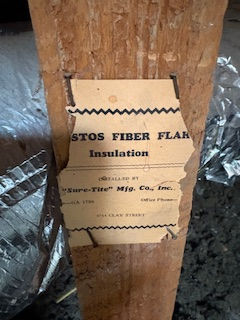
Here’s where things get a little more interesting—but still not panic-worthy.
A large portion of vermiculite used in the U.S. came from a mine in Libby, Montana. Unfortunately, that mine had natural asbestos contamination mixed in with the vermiculite.
What does that mean?
The vermiculite itself isn’t asbestos
But some of it—especially from Libby—contained asbestos fibers
Typically, that contamination ranged around 3% to 7% at the source.
Now before you start mentally packing your attic into a biohazard bag, here’s the important part:
It is extremely rare to see anything close to those percentages in Colorado homes!
By the time materials were processed, transported, installed, and aged, most testing here shows:
Trace amounts, or
Non-detectable levels, or
Results that drop significantly after more detailed analysis
Wait… So How Much Asbestos Is Actually in It?
This is where testing gets nuanced—and honestly, kind of fascinating.
Initial lab results might show something detectable, but when we move into point counting (a more detailed analysis method), levels often drop below 1% asbestos content.
Why does that matter?
Because >1% is the regulatory line that changes how materials are handled.
And yes, this is where things get a little “government meets science meets paperwork.”
<1% vs >1% Asbestos: Why Everyone Suddenly Cares About Math
Let’s break this down in human terms.
If Vermiculite Tests Less Than 1% Asbestos

This typically falls under:
OSHA-related handling requirements
Still requires care, but not full regulatory abatement
Think:
“Handle it smartly, don’t go wild with a shop vac, and maybe don’t host a demolition party in your attic.”
If Vermiculite Tests Greater Than 1% Asbestos
Now we’re in:
Regulated asbestos removal territory
Full containment, proper abatement procedures, licensed contractors
Think:
“This is now a whole process, not a weekend project.”
Reality Check for Colorado
Here’s the grounded, non-alarmist truth:
Most vermiculite we see locally in the Denver Metro Area ends up:
At trace levels, or
Below 1% after point counting
Which means:
It’s often managed, not automatically removed
Decisions are based on condition and planned disturbance—not fear
If you’re curious how sampling works and why numbers matter, check out: “Essential Asbestos Testing: How Many Samples Are Required in Colorado?”
When Is Vermiculite Actually a Risk?
Here’s where people tend to overcorrect.
Vermiculite sitting quietly in your attic is basically the introvert of building materials—it’s not bothering anyone.
The concern comes in when it’s disturbed.
Examples of Disturbance:
Renovations
Drilling into ceilings/walls
Removing insulation
Aggressive cleaning (please step away from the leaf blower)
I like to compare it to a bee. If you leave it alone, it leaves you alone. This goes for all asbestos containing material really!
Let’s Keep This Calm: What’s the Actual Health Risk?

Here’s the balanced version:
Asbestos exposure risk depends on concentration + disturbance + duration
Occasional, minimal exposure is not the same as occupational exposure over years
The biggest risks historically came from workers directly handling contaminated material daily
So no—you discovering vermiculite in your attic does not mean your house is secretly plotting against you.
It just means you should make informed decisions before messing with it.
Fun Fact: The name “vermiculite” comes from the Latin word for “worm,” because it expands into worm-like shapes when heated. Science is fun and slightly unsettling.
So… Should You Remove It?
Ah yes, the million-dollar (sometimes literally) question. The answer is annoyingly… it depends.
You might not need to remove it if:
It’s undisturbed
You’re not renovating
It’s in good condition
You should consider action if:
You’re planning renovations
It’s being disturbed
You want peace of mind before a project
Want a deeper breakdown of how materials release fibers? Read: Myth: Non-Friable Material Is Safe – The Real Difference Between Friable and Non-Friable Materials. It’s one of the most important concepts homeowners overlook.
Testing Vermiculite: What to Expect

Testing vermiculite isn’t quite as straightforward as other materials.
Because it’s loose-fill, sampling has to be:
Representative
Carefully collected
Properly analyzed
And sometimes results require additional analysis like point counting to get the full picture.
This is one of those times where guessing is not your friend.
The Biggest Mistake Homeowners Make with Vermiculite?
It’s not having vermiculite. It’s doing one of these:
Ignoring it during renovations
Disturbing it without testing
Assuming the worst without data
Or… Googling themselves into a full existential crisis
Let’s avoid all of those. That's why you have us!
Fun Fact: Entire neighborhoods built during certain decades almost guarantee vermiculite in the attic. If you found it, you’re not unlucky—you’re just historically on trend.
The Bottom Line (No Fear, Just Facts)
Vermiculite is a common, historically used insulation
Some of it—especially from Libby, Montana—contained asbestos
In Colorado, high percentages are rare
Most results fall into trace or below 1% after analysis
Risk depends on disturbance, not just presence
So instead of panic: Pause, test, plan.
If you do find regulated asbestos and aren’t sure what to do next, you can call us or read So You Have Asbestos—Now What? . This walks you through it step-by-step without the overwhelm.
Final Thought + Call to Action
Your attic isn’t dangerous—it’s just misunderstood.
If you’ve found vermiculite, the smartest move isn’t to panic or ignore it. It’s to:
Pause before disturbing anything
Get proper asbestos testing
Make a plan based on real data—not assumptions
We provide asbestos testing for vermiculite insulation in Denver, Aurora, Centennial, Lakewood, and surrounding Colorado areas. Without turning it into a horror story.
Because the goal isn’t fear.
It’s clarity, safety, and making smart decisions for your home.

Related Keywords
vermiculite insulation, asbestos testing in Colorado, vermiculite insulation, vermiculite attic insulation, vermiculite insulation Colorado, loose fill vermiculite insulation, what vermiculite insulation looks like, vermiculite asbestos, does vermiculite contain asbestos, vermiculite asbestos risk, Libby Montana vermiculite asbestos, vermiculite insulation asbestos percentage, asbestos in vermiculite insulation Colorado, asbestos testing vermiculite, asbestos testing attic insulation, Colorado asbestos testing requirements, point counting asbestos vermiculite, difference between less than 1% and greater than 1% asbestos, should I remove vermiculite insulation, is vermiculite insulation dangerous, can I leave vermiculite insulation in my attic, buying a house with vermiculite insulation, and what to do if you find vermiculite are especially valuable, asbestos testing Denver, vermiculite insulation Denver Colorado, asbestos inspection Centennial, Lakewood asbestos testing


The part about testing "isn't quite as straightforward" for loose-fill material is worth underlining. A lot of homeowners test once, usually during a home purchase, and assume that result holds forever. It doesn't always. Vermiculite settles and shifts over the years, and a resample before a renovation can come back different from the original. We handle both sides of this at Lakewood Insulation Contractors, testing and clearance work along with the insulation that goes back in afterward, so nothing gets started based on an outdated sample.